Before
- Purchase orders arrive as PDFs from dozens of customers, and no two look alike: system printouts, faxes, crooked scans, cover sheets, handwritten forms.
- Customer service retypes every PO into the ERP by hand, translating customer and old part numbers, units and prices from memory.
- Price mismatches, new ship-to addresses and missing PO numbers are caught by eye, if they're caught.
After
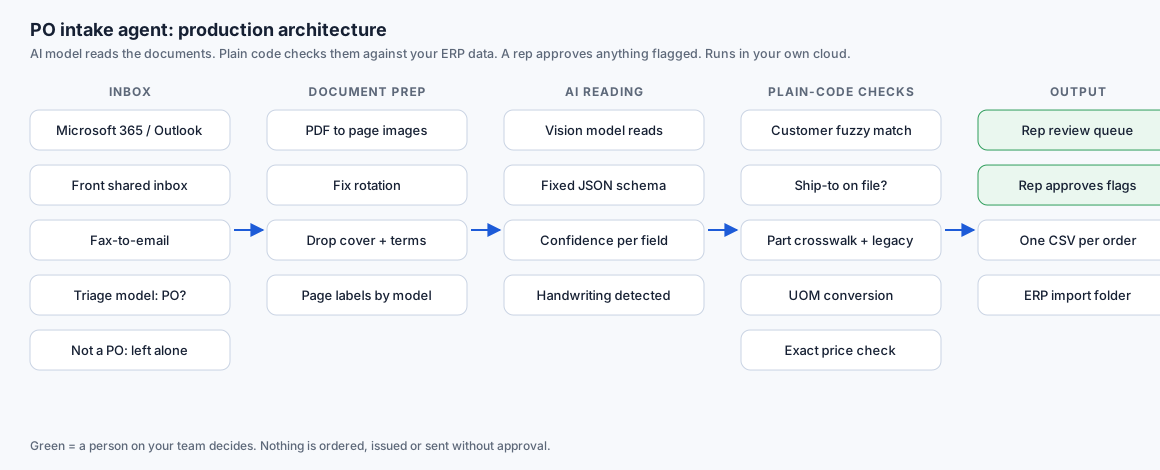
- An AI vision model reads each page: it spots POs in the inbox, turns rotated pages upright, skips cover and terms pages, and fills a fixed set of fields with a confidence for each.
- Plain code checks everything against your ERP data: customers, ship-tos, item numbers (customer and legacy too), units and exact prices.
- Anything unsure is flagged with a plain reason for a rep. Clean orders come out as one CSV per order in your ERP's import format.
1 · Order inbox (the model sorted each email: PO, not a PO, or unsure)
| From | Subject | Attachment | Model says | Why |
|---|
Open a PO:
2 · Pages (model labels each page and its rotation; only PO pages are read)
3 · Fields the model read (confidence per field)
| Field | Value | Confidence |
|---|
4 · ERP checks (plain code, no AI)
Flags for the rep
Line items (as read → matched to your item master and price list)
| Ln | On the PO | Your item | Matched by | Qty | UOM | Qty (EA) | PO price | List price | Check |
|---|
5 · ERP import CSV (one file per order, fixed columns)
Raw model output (JSON)
Try your own PO (PDF, up to 3 pages and 5 MB; pages are turned into images in your browser and read by the same model; limited runs per day)
Please use a sample or a PO with personal details removed. Files are not stored.
No file chosen
Measured accuracy on the samples
| Field | Correct | Accuracy |
|---|
| Sample | Fields | Pages | ERP match | Status |
|---|
How it works
- Triage. A small model call reads each email's sender, subject, body and attachment names and labels it PO, not a PO, or unsure. Unsure goes to a person.
- Prepare pages. The PDF becomes page images. The model labels each page (PO, cover, terms) and says how it's rotated; code turns it upright and drops cover and terms pages.
- Read. A vision model fills a fixed JSON schema (PO number, customer, bill-to, ship-to, dates, ship via, carrier account, notes, line items) with a confidence for every field. No per-customer templates.
- Check. Plain code matches the customer (fuzzy name + address), the ship-to on file, items via your item number, customer part crosswalk or legacy part list, converts units, and compares prices exactly to the price list.
- Flag. Low confidence, missing PO numbers, new ship-tos, unknown items, unsold units and price mismatches each get a plain reason. Handwritten orders always go to a rep.
- Write. One CSV per order, in a fixed column format, dropped where the ERP import already looks. Flagged orders wait for a rep.
Production architecture